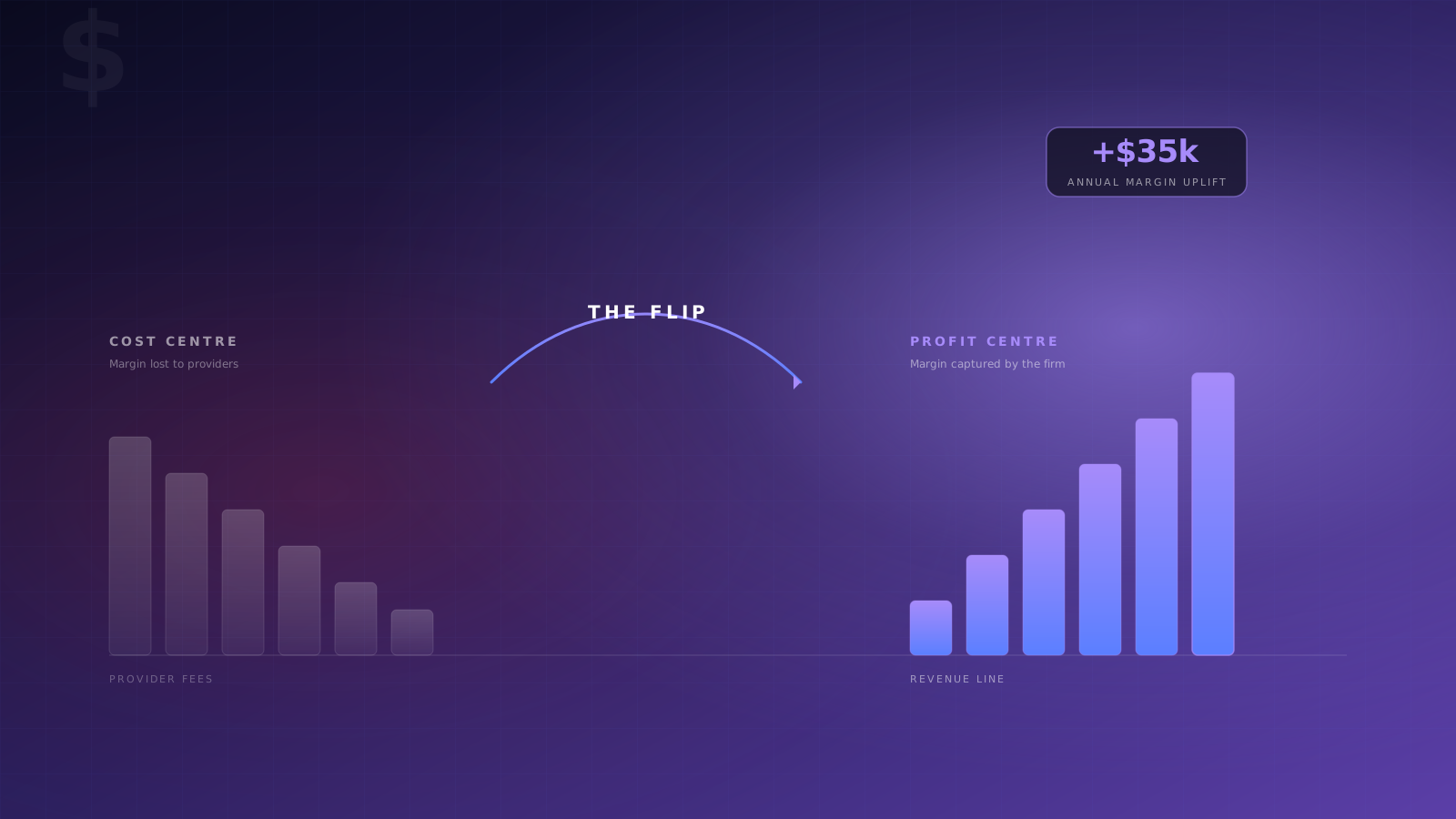
Most firms treat IP renewals as a cost centre. Something to outsource to a third-party provider, mark up modestly, and pass through to the client. It’s “operational.” It’s “low-margin.” It’s “not where we add value.”
That’s the framing the renewal providers have spent twenty years selling you. And it’s broken your unit economics in ways you may not have noticed.
The traditional renewal model
When you outsource renewals to a traditional provider, here’s what happens:
- The provider charges the client directly, or charges you and takes a marked-up cut.
- The provider owns the operational workflow — calculation, payment, confirmation.
- The provider also quietly owns parts of the client relationship. Status emails come from them. Renewal notices arrive on their letterhead.
- You take a small margin on the markup, if any. Most of the economics flow to the provider.
This model made sense when renewals were operationally heavy and software didn’t exist to automate them. It does not make sense today. The operational work is now mostly software. The margin going to renewal providers is largely rent on the fact that you haven’t switched yet.
The economics on a typical portfolio
Let’s run the numbers. Take a 100-renewal portfolio with an average renewal cost of $700 across jurisdictions.
Traditional model:
- You collect ~$840 per renewal from the client (20% markup).
- Provider takes $700 of that to cover the renewal plus their service fee.
- Your net margin: ~$140 per renewal × 100 = $14,000/year.
RenewalEngine model:
- You still collect ~$840 per renewal from the client.
- Your actual cost via RenewalEngine averages ~$500 (27.7% lower than traditional providers, on the same 11-country benchmark we publish).
- Your net margin: ~$340 per renewal × 100 = $34,000/year.
That’s a $20,000/year improvement on 100 renewals. Scale that to 500 renewals and it’s $100,000. To 2,000 it’s $400,000. And the work doesn’t get harder, because the engine does it.
What “the flip” actually means
The flip isn’t replacing your client relationship. It’s replacing the third-party provider with infrastructure you control.
You keep ownership of the client. You keep the brand of every email and notice. You keep the operational visibility. What changes is the back-end: instead of a marked-up renewal provider taking the margin, an automated infrastructure layer runs the workflow for a fraction of the cost.
Mechanically:
- RenewalEngine handles the office payments, currency conversions, confirmations, document storage.
- Your firm wraps the service in your own branding, your own client communications, your own pricing.
- The savings vs. a traditional provider show up directly in your margin.
The objection — and the answer
The most common pushback: “We don’t want to take on the operational risk.”
Fair concern. But the operational risk is already on you — when a traditional provider misses a renewal deadline, your client still calls you. The difference is that with infrastructure you control, you actually have visibility into the workflow, audit trails, and forecasting. You’re not less safe. You’re more in control.
If your firm is doing more than 50 renewals a year and using a third-party provider, you’re leaving money on the table. The math isn’t subtle. We’re happy to run the numbers on your specific portfolio.